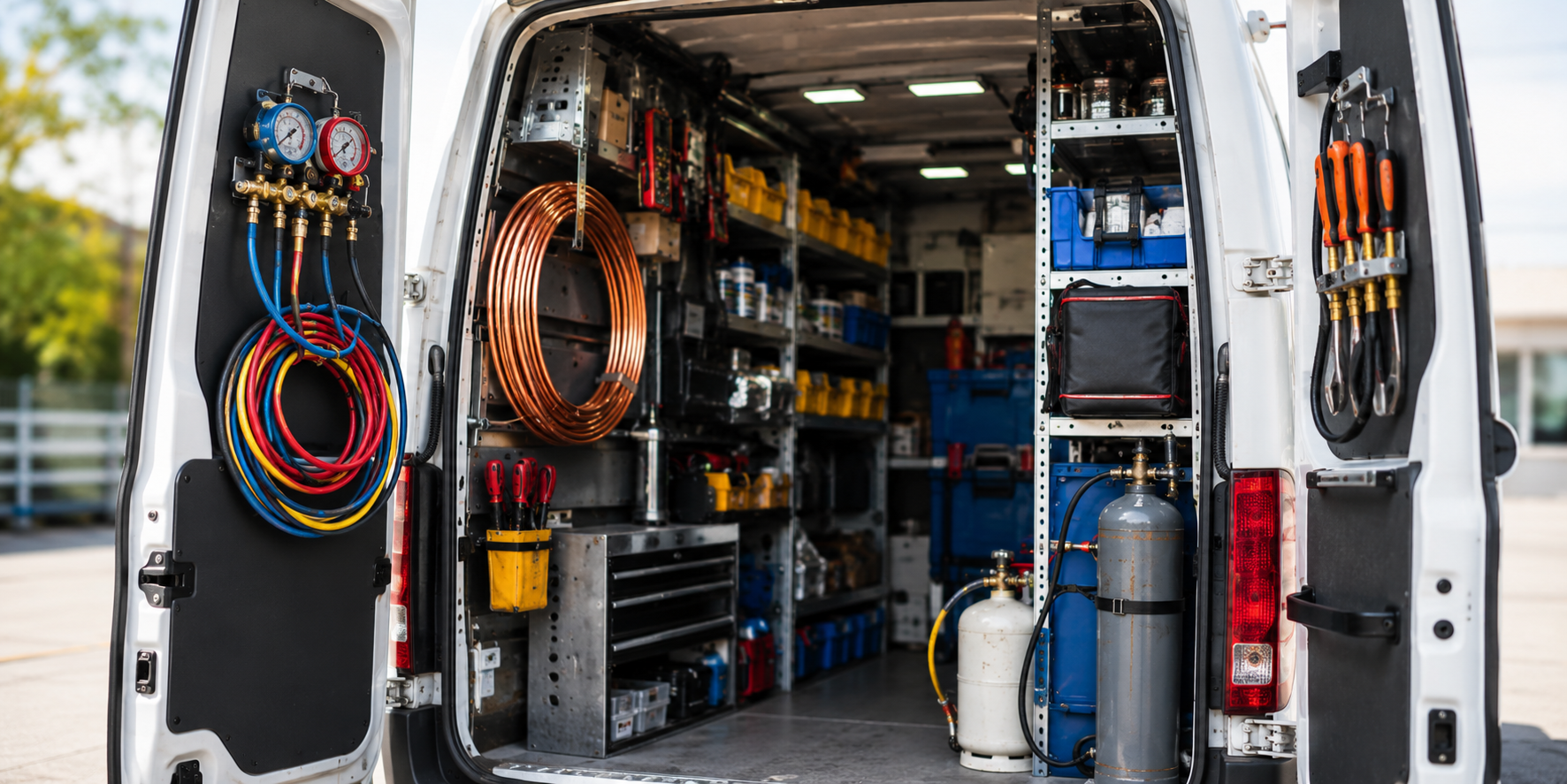
An HVAC truck stock list is the agreed set of parts, tools and consumables every service van carries so a tech can finish most jobs without a trip back to the supply house. This guide gives you a categorized starter list, shows how much to keep, and explains how to keep each truck accurate with HVAC inventory software. There is a free download at the end.
The reason it matters is simple math. A tech who arrives at a no-cool call without the right capacitor drives back for it, and a job that should close in one visit turns into two. Across a fleet, those return trips cost real hours and real money. A well-stocked truck is what lets you fix most calls on the first visit.
What is an HVAC truck stock list?
It is the standard load-out for a service van: the items a tech needs on hand for common service and maintenance calls, organized so they are easy to find and easy to restock. Most shops aim to complete 85 to 90% of repairs straight from truck stock, and a typical residential service truck carries somewhere between $3,000 and $8,000 in parts. The list is not about carrying everything. It is about carrying the right things, in the right amounts, for the calls you actually run.
The HVAC truck stock checklist
The full categorized list below as a checklist you can edit for your shop, then load onto your trucks and keep current. Parts, tools and consumables for every service van.
One PDF. No spam. Unsubscribe anytime.
The checklist is on its way to your email.
The HVAC truck stock list
Use this as a starting point and adjust it to the equipment lines and climate you serve. Group items by function so a tech finds them fast.
Electrical and controls
- Run capacitors and dual-run capacitors across the common sizes (5, 7.5, 10, 15, 20, 30/5 µF)
- Contactors, single and double pole for residential, three pole for light commercial
- Relays, transformers (240/208 to 24V) and a few common control boards
- Hard start kits to get a struggling compressor going
- Disconnects, 60 and 125 amp, indoor and outdoor
- Breakers, fuses, wire nuts, low-voltage wire and a roll of thermostat wire
Motors
- Universal condenser fan motors, outdoor and enclosed
- Universal indoor blower motors in both 115V and 230V
- Motor brackets and capacitors matched to the motors you carry
Heating parts
- Hot surface igniters and a universal igniter
- Flame sensors and thermocouples
- Sequencers, single and double, the part that most often fails on electric furnaces
- Pressure switches across the common ranges
- Common gas valves, limit switches and a couple of burner types
Condensate
- Condensate pumps, 115V and 230V, plus a mini-split pump
- Drain tube and a float (safety) switch
Refrigerant and line
- Refrigerant for the systems you service, plus nitrogen for pressure testing
- Copper line in common sizes (3/8, 1/2, 3/4, 7/8) with couplings and elbows
- Filter driers, schrader cores and caps, and leak detection dye
Consumables and materials
- Air filters in the sizes you see most
- Thermostats: single stage plus two-stage heat and cool (a T4 and a T6 cover most calls)
- Coil cleaner, the no-rinse evaporator foam type
- Brazing rods and flux (15% silver solder), foil tape, mastic and duct tape
- PVC fittings (couplings, tees, 90s and a trap), conduit and liquid-tight with fittings
- Silicone, self-tapping screws with bit tips, gas fittings and zip ties
Tools and diagnostics
- Manifold gauges and a quality multimeter
- Refrigerant recovery machine, vacuum pump and a torch kit
- Leak detector and a reciprocating saw
Safety
- Gloves, eye protection, hearing protection and a basic first aid kit
Stock by season
Your van should change with the calls. Heading into summer, lean on cooling parts: capacitors, contactors, condenser fan motors and hard start kits. Heading into winter, load heating parts: sequencers, pressure switches, igniters, flame sensors, thermocouples, gas valves and limit switches. A core set stays on year round, transformers, disconnects, breakers, thermostats and filters. Pull the off-season parts so they are not dead weight.
What to order instead of stock
Some parts are not worth carrying. Metering devices and TXVs, inducer motors, blower wheels, fan blades and large control modules vary too much by model, so order them against the unit's model and serial number rather than fill the van with versions you will rarely match. Keep the truck for the cheap, common, fast-moving parts and let the supply house handle the rest.
See every truck's stock in one place
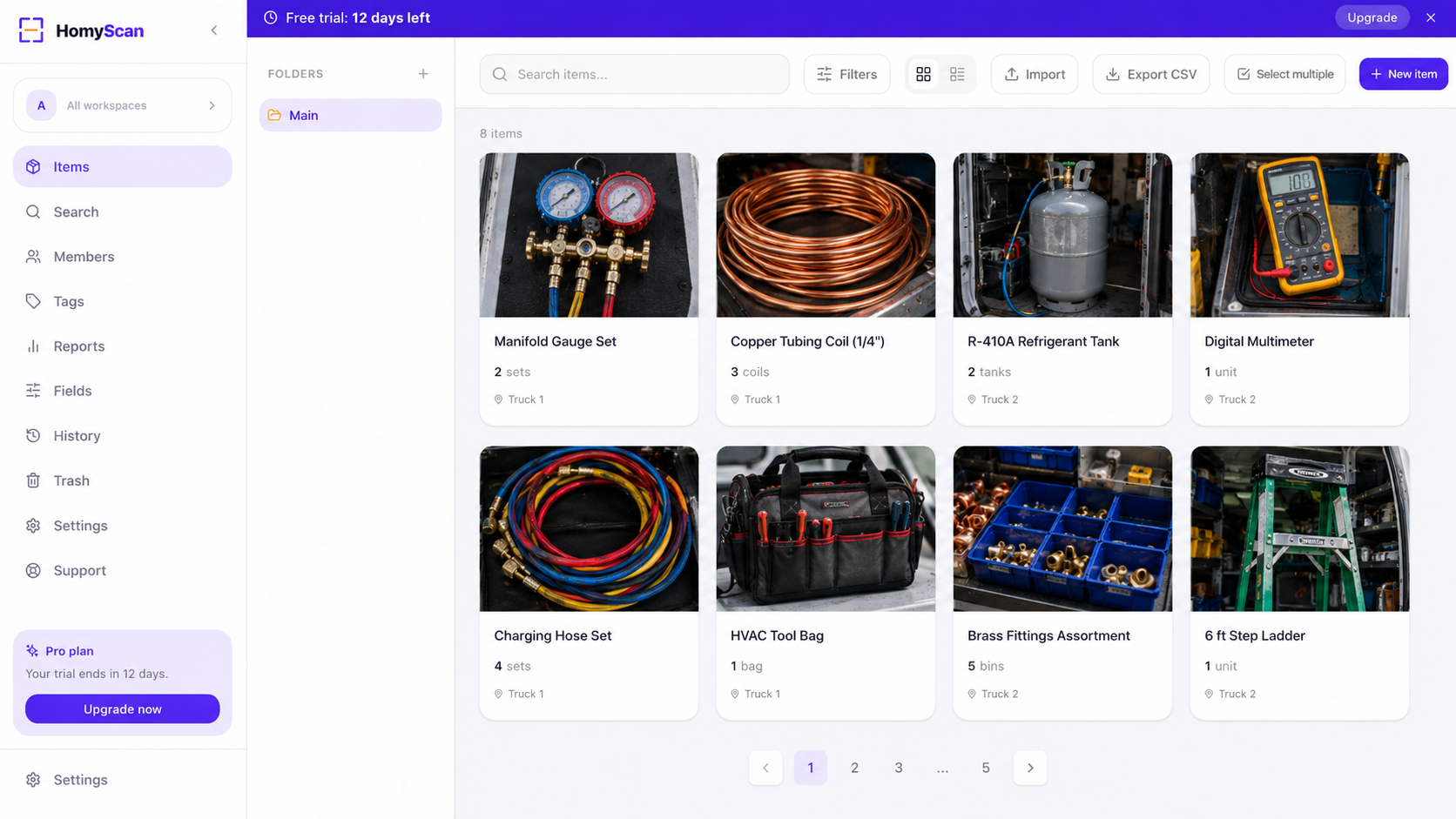
Once you know what each van should carry, the work shifts to keeping every truck matching the list. This is where HVAC inventory software replaces the spreadsheet. Each truck becomes its own location, so you see exactly what Truck 1 and Truck 2 carry, scan a part in or out from your phone, and get a low-stock alert before a van runs dry.
How much should you stock on a truck?
Budget sets the answer more than any list does. If you can spend $3,000 per truck, decide what that buys before you fill the shelves. Carry plenty of the cheap, fast-moving parts, capacitors, contactors, common motors and filters, since running out of those is what costs you a visit. Leave the expensive, slow-moving items at the shop or let your wholesaler hold them, and pull them only for the jobs that need them. A part that sits on a truck for two years is cash you parked instead of spent.
A good supplier relationship lets you carry less. If a distributor delivers daily or holds big-ticket items for you, you do not need three of a costly part sitting on every van. Use the truck for what you reach for often, and lean on the supply house for the rest. The aim is enough stock to close the call, not a warehouse on wheels.
How to right-size your truck stock
The fastest way to waste money is to guess high on day one. Field techs are near unanimous on the better approach.
Start with the bare minimum of known-failure parts for the equipment lines you sell. Then track what you actually use. When you reach for a part more than once or twice in a season, add it to the truck and carry two or three. Let the list grow from real demand rather than from a catalog.
Stock for your region and your customer base. A van in Florida does not need burner nozzles, and a shop that services mostly one brand should carry that brand's common-failure parts plus universal substitutes. Swap seasonally too, heating parts loaded before winter, cooling parts before summer, and pull the off-season stock so it is not dead weight.
If you run several trucks, standardize the layout. When every van is stocked and arranged the same way, a tech can jump into a spare truck and find everything, and your counts stay sane because you know where each item lives.
Then listen to the people driving the trucks. Your techs know what they reach for, so let them tell you what to add, give it to them, and watch whether it moves. If a part they asked for sits unused for a season, take it back to the shop. Stocking the truck is a running conversation between the field and the office, not a one-time decision, and the trucks that stay lean are the ones where someone keeps watching what actually gets used.
How to keep the list accurate
A stock list only works if the truck matches it. Most shops drift because parts come off the van without anyone logging them, so the shelf and the records stop agreeing.
Three habits fix that. Organize the van into zones with bins and clear labels so items have a home. Restock on a schedule, weekly or biweekly, with a fuller count once a month. And track each truck as its own location so you always know what is on it.
FAQ
What should be on an HVAC service truck?
The common-failure parts for the systems you service, capacitors, contactors, motors, igniters, flame sensors, filters and thermostats, plus refrigerant, your gauges, recovery machine, vacuum pump and basic safety gear.
How much inventory should each truck carry?
A residential service truck usually holds $3,000 to $8,000 in parts. Set a per-truck budget, then prioritize cheap fast-moving parts over expensive slow movers.
How often should I restock the trucks?
Restock weekly or biweekly, and run a fuller count once a month so the truck matches your records.
Is a residential truck stocked the same as an install truck?
No. A service truck leans toward repair parts for common failures, while an install truck carries more line sets, fittings, thermostats and materials for replacements.
Is a spreadsheet enough to track truck stock?
It works at the very start, but once parts move between several vans and a warehouse, a spreadsheet falls behind. Scanning each part in and out keeps every truck accurate without the manual updates.